.png)
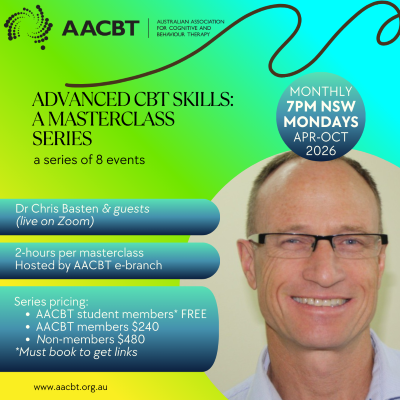
Therapy does not always go smoothly and each topic in this series of masterclasses will provide some solutions to the more common challenges in CBT.
Presented by Dr Chris Basten
University of Technology Sydney
This is a series of 8 events, all accessible via Zoom, with 2 hours CPD per event.
Or you may book one or more individual events by clicking through from the descriptions below.
| Membership type | Single ticket | Series ticket | All 8 single tickets |
| AACBT Student Member* # | Free | Free | Free |
| AACBT Full Member | $50 | $240 | $400 - save $160 |
| Non-member** | $100 | $480 | $800 - save $320 |
* AACBT Student membership is free to anyone studying, or a provisionally registered psychologist.
# Must book to receive event link/s.
** Join now and save!
Venue:
Zoom webinar
All events are NSW-based time zones
All events are live-streamed - please note that this session will be recorded and made available to those who booked
The access link/s will be provided the day prior to those registered
Book the entire masterclass series ticket here
Therapy does not always go smoothly and each topic in this series of masterclasses will provide some solutions to the more common challenges in CBT.
This series offers participants bite-size clinical masterclass sessions on eight topics that are common challenges in clinical practice of CBT. Topics include tailoring the individual case formulation, managing the therapeutic relationship, dealing with ‘resistance’ and ambivalence about change, educating clients better, avoiding therapy drift, identifying the cognition that most needs work, increasing the potency of therapy with the right ‘dose’ of behavioural principles and the final session is devoted to preventing and managing burnout. Each session is aimed at clinicians who have a sound working knowledge of CBT principles and techniques. Half of the sessions have co-presenters who have expertise in that area of practice. In addition to some didactic material, training methods include videos of therapy scenarios, group discussion, and opportunities to practice techniques.
This 90-minute masterclass + 30-minute discussion is designed to challenge participants to be more flexible with their individual case formulations (ICFs), adding features that they may not regularly use. Examples are provided on how the therapist can tailor each formulation to fit the client, rather than having a template that they apply to every client. The session explores how to add neurodivergence and other cognitive styles to an ICF. There is a focus on how a tailored ICF can be used to anticipate potential future difficulties and manage ruptures in the therapeutic alliance.
This 90-minute masterclass + 30-minute discussion is devoted to advanced skills and problem-solving in administering CBT. It is inevitable that, at certain points in therapy, clients will show their ambivalence for change in one form or another. Motivational interviewing (MI) provides a framework to respond to this ambivalence and is best done when integrated into a therapy process, rather than as a standalone intervention. Participants will have opportunities to see MI demonstrated in videos before practicing their own responses to clinical challenges in the form of a series of vignettes.
A client will not always be aware of the key cognitive engine that is driving their emotional distress or behavioural difficulties. There is often an emotionally powerful belief or assumption, the ‘hot cognition’, that causes the most intense distress and yet the client may not ever say this out aloud. This masterclass explores the less obvious cognitions that therapists must be aware of, including unspoken assumptions, core beliefs and schemas, internalised rules, and metacognitions. Techniques are provided to help the clinician to elicit the ‘hot cognitions’ and put them into words, while also helping the client to take a more reflective and observer stance. Case examples and vignettes are used for training exercises. There will be opportunities for participants to examine how to employ these techniques immediately with current clients.
Co-presented with Dr Danielle Einstein
Direct behavioural interventions are one of the pillars in CBT and can be the most effective way to get emotional change, cognitive change and even strengthen the therapeutic alliance. It is well documented, though, that many clinicians do not use behavioural interventions with the intensity and frequency that is optimal for a client. This masterclass will examine how to enhance CBT and solve common clinical challenges. Participants will be reminded of examples of key behavioural interventions and use case examples to illustrate (a) why it is understandable that a clinician may choose not to work behaviourally and (b) how to fit the most powerful interventions into a treatment plan. The presenters explain the use of the analogy of ‘dosing’ psychological treatment, just as we might with pharmacological therapies.
Co-presented with Mr Chris Thornton
Managing the therapeutic relationship well increases outcomes for several reasons including that the client is less likely to drop out, ruptures can be managed, the client will share more openly and will work harder in the therapy process. There are well-established ways to enhance the therapeutic alliance. Thus, what is referred to as ‘non-specific factors’ in therapy can be very specific indeed. This masterclass starts by reviewing what steps the CBT therapist can undertake to optimise the therapeutic relationship. Clinical case examples are used to help practice managing ruptures by responding to clients. Self-reflective exercises are used to help participants identify relative strengths and weaknesses in discussing the therapeutic ‘process’ and the working alliance openly while also focusing on therapy ‘content’ and techniques.
Co-presented with Ms Tracey McMillan
In CBT clients need to learn a lot – about the condition and its maintaining factors, about the therapy process and perhaps the role of cognition or behavioural reinforcement. We need them to understand the rationale of the proposed therapy. In brief, psychoeducation is a cornerstone of CBT, so we are educators as well as therapists. Yet we rarely study how to teach well. In this masterclass, participants will be exposed to several key educational principles, including adapting the teaching methods to the learning style suited to each client, working with the client to increase recall of key content and employing experiential learning to for the most powerful and efficient learning process.
Therapeutic drift refers to the unintended process of diluting or ceasing to use a treatment that is evidence-based or has a clear rationale. Drift is associated with poorer treatment outcomes over time. On the other hand, intentional variations in therapy can be helpful and differ from ‘drift’. In this focused masterclass, participants learn about clinician- and client-related factors that contribute to drift. A checklist is presented for preventing and managing drift before group discussions explore how to apply this is practice.
Co-presented with Dr James Clarke
Therapists often hear about self-care strategies, such as to manage our time well, cultivate good relationships within and outside work, exercise, meditate more, and have a good work-life balance. Yet, even when these sound ideas are implemented, many mental health professionals find themselves experiencing a degree of burnout. This masterclass starts with a brief overview of the literature on burnout with a focus on ‘emotional burden’ and the role of therapist beliefs that we are not always aware of. These two lenses provide a way for self-assessment within the masterclass, before ways to protect from and recover from burnout are discussed. By the end of the session, participants will have a greater understanding of the factors that may elevate their own likelihood of burnout and how to reduce their own emotional burden.
These events are hosted by the e-Branch of AACBT.
About this series of events:
Each session is 2-hours total: 90-min presentation plus 30-min Q&A / discussion – bring your thoughts and questions!
Access to Zoom link from 6:45pm for a 7:00pm start (NSW).
Please note that as the training is an interactive web-based training (not a webinar) which may include health-related information, participants must agree to the ‘no recording’ policy and join from a private space where confidentiality can be maintained.
This series is aimed at clinicians who have a sound working knowledge of CBT principles and techniques.
References will include:
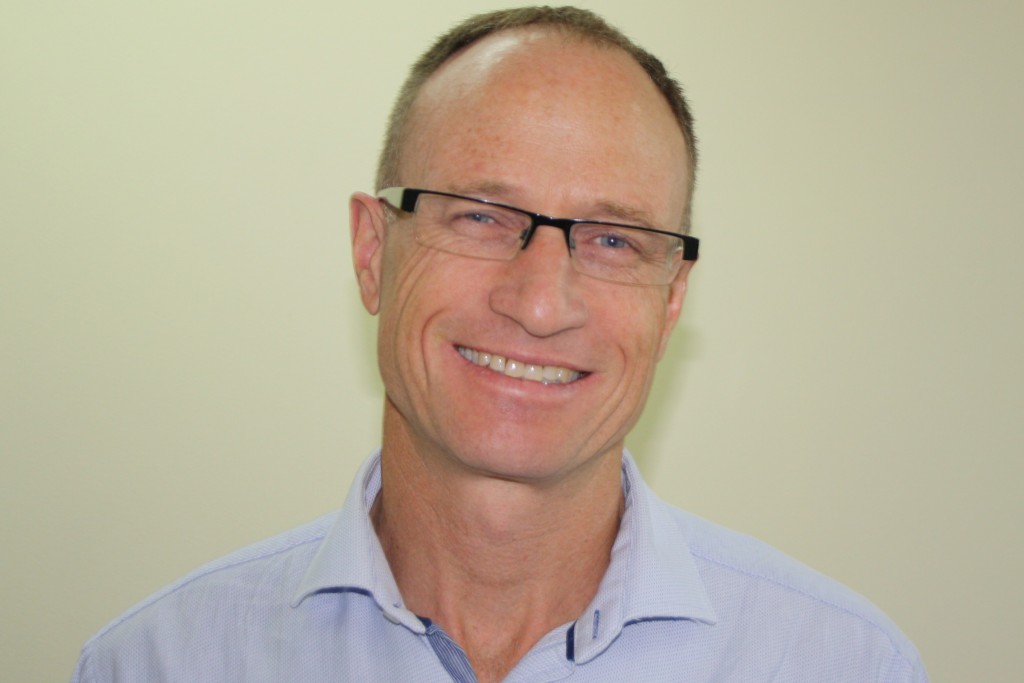
Chris Basten is a Clinical Psychologist with interests in health psychology and eating disorders. He received his master’s in clinical psychology then a PhD from University of Sydney. He worked for 15 years at Westmead Hospital in consultation-liaison psychiatry and the eating disorders unit. He has casual lecturer roles, including at the University of Technology Sydney and University of NSW. For several years now he has focused on his own practice and training health professionals. Chris is an author of the book ‘The Art of CBT’ and has presented some of his research at conferences and has contributed to several peer review articles.
Book the entire masterclass series ticket here
Are there any refunds?
Cancellations attract a 25% processing fee. Cancellations within one week of the event attract a 50% processing fee. Cancellations within 24 hours of the event will not be refunded under any circumstances. If you wish to transfer the name of your registration to someone else there is no charge.
There are NO refunds if you attend 5 (five) events, or any purchases after 20 July 2026.
How do I get access to the live-stream?
You will be provided with the Zoom link on the day prior to the event - it is your responsibility to ensure that you have Zoom installed and ready to begin.
How many people may attend per ticket/registration?
A registration is for one person. To successfully manage the event, we expect only one person to join the webinar as part of your registration.
May I record the session?
You agree not to record the meeting in any way. You agree not to distribute materials to other persons without prior agreement.
If I book, will I get access to the AACBT recording?
Yes, we will distribute a limited-time access link after the event has concluded.
